Writing · 28 October 2026 · Dagens Næringsliv
I'm selling everything and leaving.
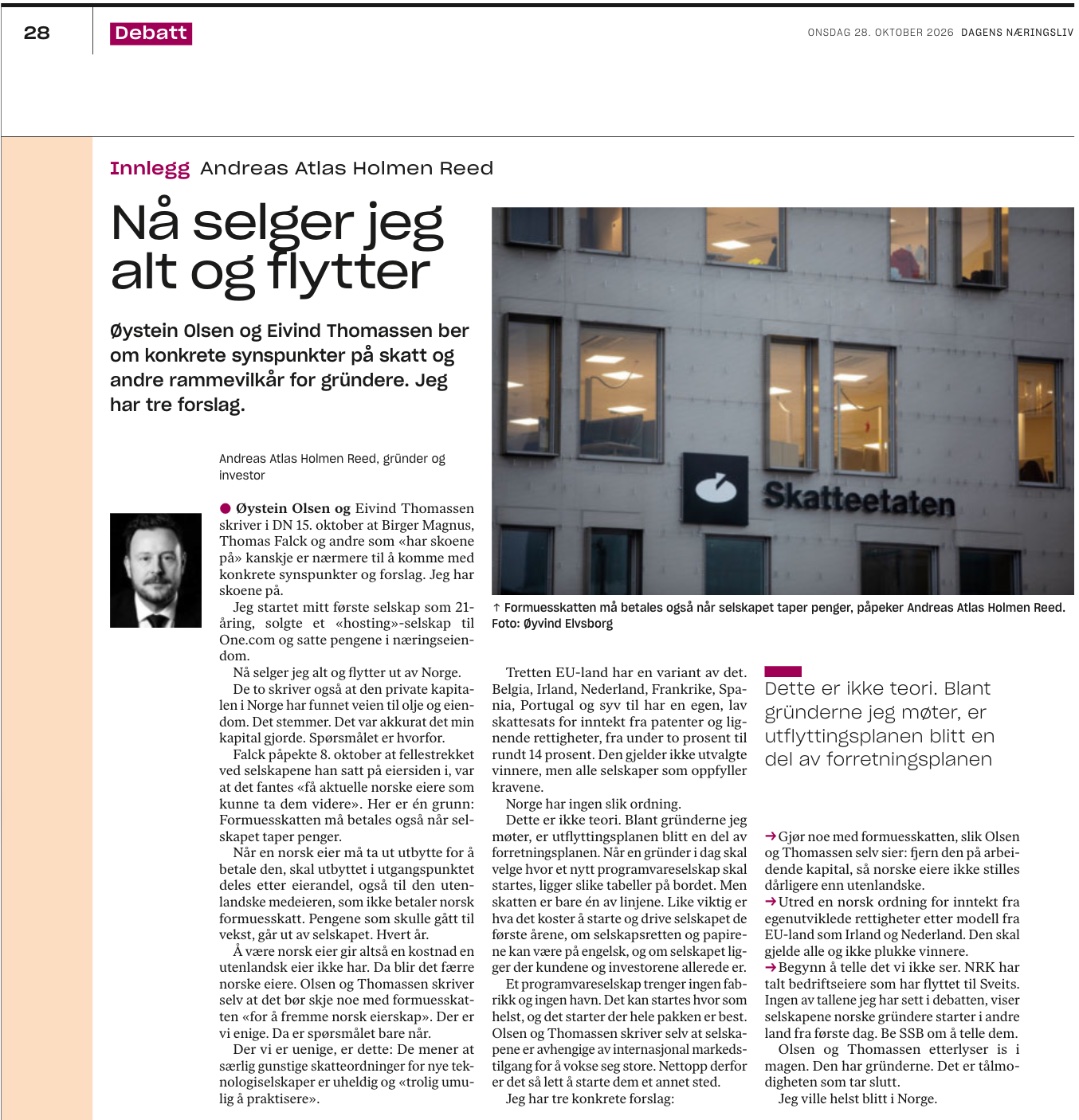
On 15 October, Øystein Olsen and Eivind Thomassen wrote in Dagens Næringsliv that founders and investors who «wear the shoes» might be better placed to offer concrete views and proposals. I wear the shoes. This is my answer, published online on 27 October and in print on 28 October.
I started my first company at 21, sold a hosting company to One.com, and put the money into commercial property. Now I'm selling everything and leaving Norway.
They also write that private capital in Norway has found its way into oil and property. That's true. It's exactly where my capital went. The question is why.
A cost only Norwegian owners carry
Thomas Falck pointed out that the companies he owned had one thing in common: there were «few relevant Norwegian owners who could take them further». Here is one reason. The wealth tax has to be paid even when the company is losing money.
When a Norwegian owner has to take a dividend to pay it, the dividend is as a rule split by ownership, including to the foreign co-owner, who pays no Norwegian wealth tax. Money meant for growth leaves the company. Every year.
Being a Norwegian owner carries a cost a foreign owner doesn't have. So there are fewer Norwegian owners. Olsen and Thomassen write themselves that something should be done about the wealth tax «to promote Norwegian ownership». We agree. The only question is when.
Where we disagree
They believe that especially favourable tax schemes for new technology companies are unfortunate and «probably impossible to practise».
Thirteen EU countries have a version of it. Belgium, Ireland, the Netherlands, France, Spain, Portugal and seven others have a separate, low tax rate for income from patents and similar rights, from under two percent to around 14 percent. It doesn't apply to hand-picked winners, but to every company that meets the requirements.
Norway has no such scheme.
This isn't theory. Among the founders I meet, the exit plan has become part of the business plan. When a founder today chooses where to start a new software company, tables like these are on the table. But tax is only one line. Just as important is what it costs to start and run the company in the early years, whether company law and paperwork can be in English, and whether the company sits where its customers and investors already are.
A software company needs no factory and no harbour. It can be started anywhere, and it starts where the whole package is best. Olsen and Thomassen write themselves that these companies depend on international market access to grow large. That is exactly why it is so easy to start them somewhere else.
Three proposals
- Do something about the wealth tax, as Olsen and Thomassen say themselves: remove it on working capital, so Norwegian owners are not put at a disadvantage to foreign ones.
- Study a Norwegian scheme for income from self-developed intellectual property, modelled on EU countries such as Ireland and the Netherlands. It should apply to everyone and not pick winners.
- Start counting what we don't see. NRK has counted business owners who moved to Switzerland. None of the figures I have seen in the debate show the companies Norwegian founders start in other countries from day one. Ask Statistics Norway to count them.
Olsen and Thomassen call for a cool head. Founders have one. It's their patience that is running out.
I would rather have stayed.